

The perianal, perineal and perigenital regions of the dog constitute an anatomical territory whose complexity is frequently underestimated in routine consultation. Yet the dermatoses that occur there are common, polymorphic and liable to cause significant morbidity. Intractable pruritus, chronic pain, ulcerative or nodular lesions: these are all clinical presentations that demand a structured diagnostic approach. At the recent ESVD congress, our colleague Elisa Maina from the University of Bern provided a comprehensive overview of these various dermatoses.
The multiplicity of anatomical structures concentrated in this area — anal sacs, hepatoid glands, keratinised squamous epithelium, external genitalia — explains the nosological diversity of the conditions encountered. From simple allergic pruritus to neoplasia with high metastatic potential, and including immune-mediated perianal fistula, each clinical entity requires precise recognition and an appropriate therapeutic approach. The perineal region, for its part, is distinguished by its permanent exposure to faecal matter, urine and exogenous irritants, making it a zone of particular dermatological vulnerability. The perigenital region, which encompasses the external genitalia of both sexes, presents its own clinical specificities, from vulvar skin fold dermatitis in the female to scrotal dermatitis in the male.
Anatomical Foundations: An Essential Clinical Prerequisite
Architecture of the Perianal Region
The perianal region is structurally more complex than its external appearance alone might suggest. The anus is subdivided into three functionally and histologically distinct zones. The columnar zone, the most proximal, is directly continuous with the rectal mucosa. The intermediate zone represents a transitional area. Finally, the cutaneous zone, composed of keratinised squamous epithelium, is of primary clinical importance: it is here that the hepatoid glands, also referred to as circumanal or perianal glands, are located, along with the openings of the excretory ducts of the anal sacs.
This anatomical distinction is not trivial. Many conditions display a selective tropism for one or another of these sub-zones, which directly influences their clinical expression and differential diagnosis. Confusing a lesion of the cutaneous zone with a strictly mucosal or rectal pathology constitutes a diagnostic error with potentially harmful therapeutic consequences. The perianal cutaneous zone, by virtue of the nature of its keratinised epithelium and the density of glandular structures it contains, represents the preferential site of hepatoid gland neoplasias and chronic inflammatory processes such as perianal fistula. Its precise clinical recognition is therefore an indispensable prerequisite for any serious diagnostic approach in this region.
The Anal Sacs: Structure, Contents and Physiology
The anal sacs, also referred to as perianal sacs, are two bilateral pouches nestled within the subcutaneous tissue, whose excretory ducts open precisely into the cutaneous portion of the anus. Their wall is composed of two glandular types: sebaceous glands, distributed mainly along the duct, and apocrine glands, lining the internal wall of the sac itself. The contents of these structures result from the combination of these glandular secretions, to which desquamated keratinocytes and fluid are added. This mixture presents notable individual characteristics in terms of colour, consistency and odour, which explains the macroscopic variability observed between animals during clinical examination.
Physiological emptying of these contents is achieved by a mechanical mechanism: the pressure exerted by the faecal bolus during transit, coupled with the contraction of the perineal musculature at the time of defaecation. This physiological mechanism is therefore closely dependent upon faecal consistency, perineal muscle tone, and the absence of ductal obstruction. When these mechanisms are insufficient — owing to abnormal faecal consistency, muscular tonal deficit, or local inflammation — the contents accumulate and may progress towards increasingly severe pathological states, from impaction to abscess, passing through sacculitis. An understanding of this physiology is essential for identifying predisposing factors and preventing recurrence.
The Perineal and Perigenital Region
The perineal region corresponds anatomically to the diamond-shaped zone bounded cranially by the base of the tail and caudally by the base of the external genitalia. Its permanent exposure to urine, faecal matter and exogenous irritants makes it a particularly vulnerable zone for dermatoses, all the more so in breeds presenting reduced hair density over this area. This limited hair cover leaves the epidermis directly exposed to chemical and mechanical agents arising from the immediate environment, thereby facilitating the development of irritant dermatitis, bacterial or fungal superinfection, and chronic maceration lesions. The perigenital region, for its part, encompasses the external genitalia of both sexes, with specific clinical entities according to sex — vulvar skin fold dermatitis in the female and scrotal dermatitis in the male — which will be addressed in the dedicated sections. Perigenital tumours, although less frequent than those of the perianal region, also constitute a differential diagnosis to consider when faced with any progressively growing mass in this location.
Semiology and Initial Diagnostic Approach
Interpreting Behaviours: Scooting and Licking
The practitioner faced with a dog presented for licking or rubbing the perianal region on the ground must first place these behaviours in their physiological context before concluding that a pathology is present. Published data indicate that 24% of clinically healthy dogs spontaneously adopt this “scooting” behaviour, whilst 36% lick the perianal region with a mean intensity rated at 3.5 on a scale of 10. These figures bear witness to normal behavioural variability and invite caution in interpretation. Licking and rubbing of the perianal region may indeed be part of perfectly physiological grooming behaviours in the canine species.
It is the increase in frequency and intensity of these behaviours, relative to the animal’s baseline behaviour, that should alert the clinician and point towards a subclinical or clinical pathology. Excessive licking, increased irritability when the region is handled, or self-mutilation should be considered as warning signs justifying thorough examination. The history should systematically establish the duration of the signs, their continuous or intermittent character, the occurrence of recent digestive episodes — particularly diarrhoeal episodes — and any known allergic or dermatological history in the animal. This information enables early orientation of the diagnostic approach towards one of the major aetiological categories: anal sac disorders, allergic dermatoses, immune-mediated processes, or neoplasia.
Differentiating Anal Sac Disease from Strictly Cutaneous Dermatosis
The first diagnostic step, when faced with these presenting signs, is to establish whether the origin is glandular — that is, related to the anal sacs — or purely cutaneous. This distinction determines the entire subsequent approach. Digital internal rectal palpation remains the reference method: it enables assessment of sac symmetry, degree of repletion, the presence of elicited pain, and the consistency of the contents. A superficial examination limited to external observation without internal palpation is insufficient and exposes the clinician to diagnostic errors through inadequate lesion characterisation. Any pain that may be present must nevertheless be taken into account before performing this examination.
A point worthy of emphasis, as it is a frequent source of diagnostic errors: macroscopic and microscopic evaluation of anal sac contents is not predictive of disease. Bacteria — both intracellular and extracellular — neutrophils, and Malassezia yeasts are regularly found in samples taken from the anal sacs of healthy dogs. Systematic bacteriological culture of the contents, performed without a clinical context of confirmed abscess, therefore provides no isolated diagnostic value. The practitioner who bases their therapeutic decision solely on these cytological or microbiological results would be exposed to prescribing errors, notably unjustified antibiotic therapy. Diagnosis rests fundamentally upon the demonstration of clinically detectable tissue inflammation and pain elicited upon palpation.
Anal Sac Disorders: From the Functional to the Pathological
Non-neoplastic anal sac disorders represent a frequent reason for consultation in general veterinary practice, with an annual prevalence estimated at 4.40% in British first-opinion practices. Impaction constitutes the most common form, representing nearly 79% of cases, followed by sacculitis (12%) and abscess (9%). Marked breed predispositions have been documented: brachycephalic types present a 2.6-fold greater risk of developing anal sac disease compared to dolichocephalic types. The Cavalier King Charles Spaniel, King Charles Spaniel, Cockapoos and Bichons Frisés are among the most at-risk breeds. Conversely, the Labrador Retriever, German Shepherd Dog, Border Collie and Boxer present a reduced risk compared to crossbred dogs. These epidemiological data have direct practical implications: breed must be integrated into risk stratification during history-taking, and systematic identification of an underlying allergic disease — notably atopic dermatitis, the primary comorbidity associated with recurrent sacculitis — determines the effectiveness of long-term management.
An Evolutionary Continuum: Impaction, Sacculitis and Abscess
These three clinical entities do not constitute independent conditions but rather successive stages of the same evolving pathological process. Understanding this continuum is essential for adapting management to each stage and for anticipating potential complications when initial treatment is insufficient or delayed. Each stage possesses its own clinical characteristics, specific treatment, and therapeutic limits to be respected.
Anal Sac Impaction
Impaction is defined by the excessive accumulation of thickened or desiccated contents within one or both anal sacs. Clinical signs remain, at this stage, relatively discrete: predominantly perianal pruritus, erythema and scaling secondary to pruritus in advanced forms. The sacs are neither inflamed nor painful and can be expressed without notable resistance upon palpation. This relative clinical simplicity sometimes contrasts with the functional discomfort experienced by the animal, which may manifest as a marked increase in licking or scooting behaviour.
Management rests upon manual expression of the sacs — a simple procedure whose benefit remains limited if not accompanied by identification and treatment of the underlying cause. Aetiological factors to systematically investigate include dietary abnormalities, particularly a low-residue diet that produces small, insufficiently firm stools to exert effective mechanical pressure on the sacs; chronic allergic conditions that may alter the quality and quantity of secretions; and repeated episodes of diarrhoea that disrupt the physiological emptying mechanism. Antibiotic therapy and analgesia are not indicated at this stage; their prescription constitutes a therapeutic error by excess. Regular scheduled expressions, combined with dietary correction, are generally sufficient to control recurrent impaction when the predisposing cause has been correctly identified.
Sacculitis
Sacculitis corresponds to inflammation of the anal sac, most often presenting unilaterally. The clinical evolution follows a characteristic pattern: initially pruritic, the presentation progressively shifts to become painful as the inflammation intensifies. Examination reveals perianal oedema, visible swelling, marked erythema, and sacs with purulent or haemorrhagic contents. Palpation of the sacs is painful, which clearly distinguishes sacculitis from simple impaction and renders handling of the region difficult in a conscious, unsedated animal.
Treatment of sacculitis rests upon expression of the sacs under sedation — pain making manipulation impossible without prior analgesia — followed by catheterisation and thorough flushing of the duct with physiological saline or an antiseptic solution. A protocol of intrasaccular flushing followed by infusion of a commercial preparation combining a corticosteroid, antibiotic and antifungal agent, repeated on average two to three times per animal, achieves clinical resolution in the majority of cases without recourse to systemic antibiotic therapy. Topical application of antiseptics and antimicrobials is recommended, justified by the frequent concurrent presence of superficial pyoderma. Systemic or topical analgesia must be prescribed to ensure the animal’s comfort during the inflammatory resolution phase. This protocol should be repeated at fortnightly intervals until complete clinical remission is achieved, defined as the disappearance of tissue inflammation, elicited pain, and abnormal contents. As atopic dermatitis represents the most frequently associated comorbidity in sacculitis cases, its systematic investigation must be integrated into the work-up of any recurrent condition.
Anal Sac Abscess
The abscess represents the most advanced stage of the inflammatory process. It is characterised by cutaneous fistulation, sometimes accompanied by systemic hypothermia in severe forms. A counter-intuitive clinical fact worth knowing: rupture of the abscess is often accompanied by a decrease in pain perceived by the animal, owing to the tissue decompression it produces. This apparent relief must not lead to underestimating the severity of the situation nor to delaying management, as fistulation marks a breach of the cutaneous barrier with risk of bacterial dissemination and contamination of deep tissues.
Management of the abscess involves incision at the point of maximum fluctuation, followed by swabbing for bacteriological culture and antibiotic sensitivity testing — an indispensable procedure to guide any targeted antibiotic therapy. Flushing, topical application of antiseptics and antimicrobials, and the use of anti-inflammatory agents constitute the cornerstone of treatment. Systemic antibiotic therapy is initiated only upon receipt of sensitivity testing results; clinical data nevertheless show that resolution of lesions through topical treatment alone frequently renders its use superfluous. This approach, based on sensitivity testing rather than systematic empirical antibiotic therapy, is in keeping with current recommendations for the responsible use of antibiotics in veterinary medicine.
Anal Sac Neoplasia: A Diagnosis Not to Be Missed
Apocrine Gland Adenocarcinoma of the Anal Sac
Amongst the malignant neoplasias of the perianal region, anal sac adenocarcinoma occupies a predominant position, representing 17% of malignant tumours of this region. This tumour arises from the apocrine glands of the anal sac wall. It preferentially affects older animals, most often beyond 9 years of age. Contrary to what was long put forward in older literature, large cohort studies have not demonstrated a significant sex predisposition for this tumour: neither sex presents a clearly greater risk than the other, and diagnostic vigilance must be exercised equally in males and females. However, clear breed predispositions are documented, with the English Cocker Spaniel being significantly over-represented, with a mean relative risk estimated at 7.3 compared to crossbred dogs. Its particularly aggressive biological behaviour, combined with the frequency of its incidental discovery, makes it one of the veterinary neoplasias that most imperatively justifies a systematic rectal examination at every consultation.
The clinical presentation is dominated by signs that are often unilateral: perianal swelling detectable on palpation, tenesmus, dyschezia, bleeding, and increased licking or scooting behaviours. Bilateral involvement remains possible. Notably, a substantial proportion of these tumours are discovered incidentally during a clinical examination performed for another reason, the mass remaining asymptomatic at the time of diagnosis. This observation illustrates the necessity of a systematic examination of the perianal region at every consultation, regardless of the initial indication. An animal presented for routine vaccination, dental check-up or any other reason should receive a rectal palpation if its age and clinical profile justify it.
The Paraneoplastic Syndrome of Hypercalcaemia
Apocrine gland adenocarcinoma of the anal sac has the capacity to secrete a parathyroid hormone-related protein (PTHrP). This ectopic secretion induces a paraneoplastic syndrome of humoral hypercalcaemia, reported in 25 to 90% of cases depending on the published cohort, and may manifest as polyuria-polydipsia, muscular weakness, constipation, or cardiac rhythm disturbances. This syndrome resolves following complete tumour excision, making it both a diagnostic marker and a criterion for post-surgical monitoring. In certain cases, the systemic signs related to hypercalcaemia may precede or overshadow the local perianal signs, which may lead to an initial differential diagnosis oriented towards primary hyperparathyroidism or another cause of hypercalcaemia. The presence of hypercalcaemia constitutes an independent unfavourable prognostic factor, in addition to exposing the patient to increased anaesthetic and surgical risks from a cardiovascular and renal standpoint. Measurement of serum PTHrP, combined with PTH assay and total and ionised calcium, enables clarification of the biochemical picture.
Calcium measurement is therefore an obligatory component of the pre-operative work-up, alongside complete biochemistry, urinalysis, and medical imaging aimed at evaluating local and distant extension.
Metastatic Potential and Prognostic Factors
The metastatic rate of apocrine gland adenocarcinoma of the anal sac is high, including for tumours of modest size, making it one of the most insidious veterinary neoplasias. Dissemination follows a relatively predictable pattern: initial involvement of the regional iliac or sacral lymph nodes, followed by secondary spread to the lungs, liver and spleen in the first instance, as well as to bones and other abdominal organs in advanced stages. Metastases to the vertebral canal have also been documented. The rate of lymph node metastases at presentation varies between cohorts from 26% to more than 90%, depending on imaging methods and inclusion criteria. This variability underlines that even small tumours are not free from risk: approximately 20% of animals presenting with a primary tumour smaller than 2 cm already have lymph node metastases at the time of diagnosis. This observation mandates a complete staging work-up regardless of the tumour diameter at the time of discovery. Abdominal ultrasonography and thoracic radiography constitute the first-line imaging examinations, whilst computed tomography offers superior sensitivity for the detection of small iliosacrolumbar lymph node metastases, particularly for intrapelvic nodes inaccessible to ultrasonography.
Cytologically, fine needle aspiration reveals a characteristic neuroendocrine appearance, with bare nuclei and polymorphic atypia. This cytological diagnosis must be confirmed by histopathology. Certain histological parameters carry independent prognostic value: a solid growth pattern, marked peripheral infiltration, the presence of necrosis and lymphovascular invasion are associated with an unfavourable prognosis. Median survival time varies considerably according to the treatment administered and the stage of disease. In the absence of any treatment, median survival is in the order of three months. Surgery alone achieves a median survival of approximately one year, whilst the combination of surgery with adjuvant chemotherapy or radiotherapy can significantly prolong this survival, with certain multimodal strategies associated with durations exceeding two years. Prognosis is significantly improved when the mass measures less than 2.5 cm at diagnosis, in the absence of detectable metastases, and when excision of the regional lymph nodes is performed concurrently with tumour excision. These prognostic elements underline the importance of early detection and complete, well-planned surgery. Stereotactic body radiotherapy (SBRT) represents a validated therapeutic option for the treatment of metastatic iliosacrolumbar lymph nodes when surgical resection is declined or not feasible, with high local control rates and median survival comparable to surgical approaches in recent series.
Other Neoplasias of the Anal Sac Region
Squamous cell carcinoma of the anal sac glands, although rare, constitutes a further serious condition. Its aggressive local behaviour and metastatic potential make it an entity not to be overlooked when faced with any atypical perianal lesion. Amongst the other less frequent neoplasias affecting the perianal region in the broader sense, apocrine adenomas, various mesenchymal tumours, and mast cell tumours are recorded. The latter, in particular, may present in a clinically innocuous fashion in this location, which justifies the systematic use of fine needle aspiration in the presence of any perianal nodular lesion. Each of these entities requires a cytological or histological diagnostic approach to be correctly characterised and managed.
Perianal Conditions Independent of the Anal Sacs
Perianal Erythema and Pruritus: Think Allergy
Pruritic erythema localised to the perianal zone or extending across the entire perineum represents one of the most frequent clinical manifestations in veterinary dermatology. In this context, allergic diseases play the leading role: flea allergic dermatitis (FAD), food allergy and atopic dermatitis share the causal responsibility. This clinical sign may, in certain cases, constitute the sole visible manifestation of allergic disease, without any associated generalised cutaneous involvement. A dog presenting with isolated perianal erythema, without any other identifiable cutaneous lesion, should therefore undergo a complete allergological investigation rather than simply receiving local symptomatic treatment.
The differential diagnosis incorporates parasitic infestations — fleas, intestinal parasites such as Dipylidium or hookworms — and Malassezia superinfections, yeasts whose proliferation is often secondary to an allergic predisposition. The diagnostic approach proceeds by methodical exclusion: infectious and parasitic causes are ruled out first, before embarking upon allergological investigation, including a strict dietary elimination trial when food allergy is suspected. The diagnostic uncertainty frequently observed in these cases often results from incomplete investigation or a poorly conducted elimination trial, which underlines the importance of a structured and methodical approach.
Canine Perianal Fistula: A Chronic Immune-Mediated Disease
Canine perianal fistula, also termed anal furunculosis, represents one of the most severe and most challenging perianal conditions to manage. It falls within the category of chronic inflammatory diseases of immune origin, driven by a T-lymphocyte-mediated inflammatory mechanism associated with a defect in tissue healing. This healing defect constitutes a major aggravating factor, as it maintains the patency of the fistulous tracts and compromises spontaneous resolution of lesions, even in the absence of active bacterial superinfection. The German Shepherd Dog represents more than 80% of reported cases in the literature, reflecting a strong genetic component in susceptibility to the disease. Other breeds may be affected, notably Retrievers and certain breeds with a broad, low-set tail that promotes a moist, poorly ventilated microenvironment around the anus.
The immunopathological basis of the disease is better characterised today. Allelic variations have been identified in affected German Shepherd Dogs. Histopathological analysis of lesions reveals a mononuclear cellular infiltrate dominated by CD3+ T lymphocytes with a cytokine profile consistent with a Th1-type response, notably characterised by increased expression of IL-2 and IFN-γ mRNA in lesional tissues. Overexpression of matrix metalloproteinases MMP-9 and MMP-13 in lesional skin explains the tissue healing defect that maintains the fistulous tracts. A dysfunction of the NOD2 receptor, involved in the recognition of bacterial pathogen-associated molecular patterns, has also been proposed as a contributing mechanism. Furthermore, significant dysbiosis of the cutaneous and rectal microbiota has been documented in affected German Shepherd Dogs, with significant differences in composition compared to healthy dogs. This dysbiosis changes during the resolution of lesions under immunomodulatory treatment, opening perspectives on the potential role of the microbiome in the pathogenesis of the disease. Taken together, these data position canine perianal fistula as a spontaneous animal model of fistulising Crohn’s disease in humans, with which it shares genetic and immunopathological foundations.
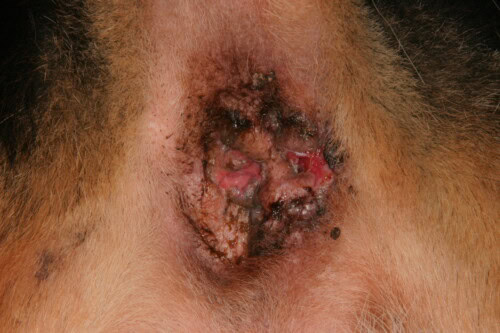
Moderate perianal fistulas
Clinical Presentation
The disease is morphologically characterised by multiple fistulous tracts and ulcers of highly variable size, ranging from discrete millimetric lesions to massive, destructive ulcerations. The typically circumferential distribution of these lesions around the anus constitutes a discriminating semiological feature, enabling distinction from the focally confined involvement of the anal sacs. This circumferential distribution reflects the diffuse involvement of the perianal cutaneous zone rather than a focal lesion related to the obstruction of a sac. Functional clinical signs comprise compulsive licking and rubbing, painful dyschezia that may lead to behavioural anorexia — the animal refusing to eat in anticipation of the pain associated with defaecation — as well as the presence of blood and exudate around the anal region.
Concomitant involvement of the anal sacs or rectum remains possible and must be actively investigated when the therapeutic response proves insufficient. Endoscopic exploration may then prove necessary to evaluate the extent of rectal mucosal involvement and to guide the therapeutic decision. Concurrent colitis has been reported in certain cases, suggesting a continuum between canine perianal fistula and chronic inflammatory bowel disease, analogous to what is observed in Crohn’s disease in humans. Furthermore, an association between food reactivity and perianal fistula has been documented in the German Shepherd Dog, justifying the addition of a dietary elimination trial to immunomodulatory treatment when frequent relapses occur despite well-conducted immunosuppression.
Therapeutic Management
A fundamental point must be firmly embedded in clinical practice: antibiotics are ineffective on the course of the underlying disease. Their isolated or prolonged use does not modify the underlying immune-mediated process — T-lymphocytic inflammation, overexpression of MMP-9 and MMP-13, healing defect — and exposes the patient to the risk of bacterial resistance. This point is all the more important given that canine perianal fistula is a frequently relapsing disease, and that repeated empirical antibiotic therapy at each recurrence constitutes a therapeutically prejudicial drift in the long term. The reference treatment rests upon immunomodulators. Oral ciclosporin constitutes the first-line molecule, with a high level of evidence: administered until clinical remission is achieved, its dose is then progressively reduced to the minimum effective threshold. The combination of ciclosporin and ketoconazole represents a validated pharmacological strategy that enables, through hepatic enzyme inhibition, an increase in the bioavailability of ciclosporin and a reduction of more than 80 to 90% in the dose required to achieve therapeutic blood concentrations. This combination significantly reduces the cost of treatment in countries where ketoconazole is inexpensive — which is not the case in France — without compromising efficacy, and should be considered as a first-line option when the owner’s budget is a constraint. In cases of failure with ciclosporin alone, the second-line strategy recommended by the most recent literature review is the combination of systemic prednisolone and topical tacrolimus, rather than topical tacrolimus alone. Topical tacrolimus represents an effective local alternative, particularly suited to moderately sized lesions when used within this combined framework. It should be noted that the use of topical tacrolimus is prohibited in certain countries, such as France; French veterinarians can therefore neither legally prescribe nor obtain this medication.
Other therapeutic options have been reported in the literature with varying levels of evidence: corticosteroids, azathioprine, oclacitinib, mycophenolate mofetil, fluorescent light therapy, and dietary modifications. The latter merit particular attention, as a predisposing dietary component is suspected in certain cases, leading some clinicians to combine an elimination trial with immunomodulation. Oclacitinib, an inhibitor of the JAK-STAT pathway involved in pro-inflammatory interleukin signalling, represents a promising therapeutic avenue whose clinical evaluation has yielded favourable results in cases resistant to ciclosporin. Fluorescent light therapy (photobiomodulation), through its anti-inflammatory and biostimulant effects on tissue healing, also constitutes an interesting adjuvant tool, notably for promoting the closure of resistant fistulous tracts. Cell-based therapies using mesenchymal stem cells represent an experimental avenue currently under exploration.
Hepatoid Gland Tumours: An Entity in Its Own Right
The hepatoid glands, a denomination derived from the histological resemblance of their cells to hepatocytes, are modified sebaceous glands confined to the perianal cutaneous zone. The tumours arising from them collectively represent 25% of all canine cutaneous tumours, making them a quantitatively major neoplastic group and one of the most frequently encountered in veterinary dermatological oncology.
Hepatoid Adenoma
Hepatoid adenoma is the most common form, appearing as solitary or multiple lesions, with a marked predilection for intact middle-aged to older males. This sex predisposition reflects a hormone-dependent pathogenesis, with androgens playing a trophic role on these glands. Nodular hyperplasia of the perianal hepatoid glands, observed in intact middle-aged males, may precede the development of a true adenoma; this benign nodular hyperplasia also constitutes an indication for castration. Diagnosis is established on the basis of clinical examination — sessile or pedunculated, fleshy mass, sometimes with an ulcerated surface — and confirmed by cytology or histology. Pre-surgical cytology provides useful information for guiding the operative decision: several cytological criteria enable distinction between benign and malignant lesions with satisfactory diagnostic accuracy, without however replacing histopathological examination.
Curative treatment systematically combines complete surgical excision of the mass with castration — surgical or chemical — the latter being indispensable for preventing tumour recurrence related to residual androgenic stimulation. Castration alone may induce partial regression of certain hepatoid adenomas, but surgical excision remains the reference treatment for eliminating the existing lesion and obtaining a definitive histological diagnosis. The prognosis is excellent, with metastases remaining exceptionally rare for the adenoma. This favourable prognosis contrasts with that of hepatoid adenocarcinoma and underlines the importance of precise histological characterisation for correctly orienting management.
Hepatoid Adenocarcinoma
Hepatoid adenocarcinoma is considerably less common. Its more aggressive biological behaviour is reflected by a greater capacity for local invasion and a higher metastatic risk than the adenoma. This difference in behaviour necessitates a more rigorous diagnostic and surgical approach, with an appropriate staging work-up — including abdominal and thoracic imaging — before any operative decision. Histological distinction between hepatoid adenoma and adenocarcinoma can prove difficult in certain cases and requires the expertise of an experienced veterinary pathologist. Histological grading systems have been proposed to refine prognostic stratification beyond the simple benign/malignant dichotomy, incorporating architectural and cytological criteria capable of predicting clinical outcome.
Dermatoses of the Perineal Region
The Diagnostic Framework: History and Chronology
The perineal region, by virtue of its anatomical location between the anus and the external genitalia, is subject to chronic exposure to faecal matter, urine, and various irritants. Breeds with low perineal hair density are particularly predisposed to dermatoses of this zone. When faced with a perineal lesion, the diagnostic approach rests upon a precise history aimed at determining the chronology of onset and evolution of the lesions. Three clinical presentations are clearly distinguished: the acute presentation, the chronic presentation, and the nodular presentation, each pointing towards a distinct aetiological spectrum and requiring an adapted diagnostic strategy.
Acute Presentation: Irritation as the Triggering Factor
An acute presentation typically occurs in the context of a recent episode of diarrhoea or faecal or urinary incontinence. Clinical examination reveals erythematous, moist skin with variable exudation. The primary differential diagnosis points towards irritant contact dermatitis — the digestive enzymes contained in diarrhoeic stools constituting the principal causative agent, with proteases and bile salts exerting a directly corrosive action on the perineal epidermis — and towards pressure sores in cases of prolonged immobility. Secondary bacterial superinfection must always be investigated by cytology, as exudative erythemas constitute a favourable environment for the proliferation of cocci and bacilli.
Chronic Presentation: The Dominant Allergic Predisposition
In its chronic form, perineal dermatosis manifests as persistent pruritus and licking. Advanced lesions present a characteristic cutaneous picture: erythema, friction alopecia, hyperpigmentation, lichenification, and marked seborrhoea. These changes bear witness to chronic cutaneous remodelling driven by self-perpetuating pruritus, in which repeated scratching and licking impair the cutaneous barrier and favour penetration by allergens and infectious agents. This vicious cycle of pruritus-lesion-pruritus lies at the heart of the pathophysiology of chronic allergic dermatitis.
The differential diagnosis is oriented primarily towards an underlying allergic dermatitis — atopic, food-related, or flea-associated — frequently complicated by bacterial pyoderma or Malassezia dermatitis. These secondary superinfections contribute to maintaining the pruritus-scratching-lesion cycle and must be treated in parallel with the primary cause. A diagnostic approach that treats only secondary infections without identifying and controlling the underlying allergic disease is doomed to fail and leads to frequent relapses.
Nodular Presentation: Neoplasias and Granulomas as Priorities
Progressively growing perineal nodular lesions, initially non-pruritic, constitute a clinical presentation requiring prompt cytological or histological investigation. The differential diagnosis must include diverse cutaneous neoplasias, infectious nodules — deep bacterial or mycotic fistulas — and parasitic granulomas. Fine needle aspiration represents the first recommended diagnostic step when faced with any perianal or perineal nodular lesion. This simple procedure, performable during consultation without sedation in most cases, enables rapid orientation towards an inflammatory, infectious, or neoplastic nature and facilitates planning of subsequent management accordingly. Biopsy with histopathological examination remains indispensable when the cytological result is inconclusive or when precise tissue characterisation is required for treatment decisions.
Perigenital Conditions: Sex-Specific Characteristics
In the Female: Vulvar Skin Fold Dermatitis
Vulvar skin fold dermatitis is a common dermatological condition in bitches, particularly observed in the presence of two major predisposing factors: obesity and hypoplastic vulva. In these anatomical configurations, the perivulvar skin folds create a warm, moist and macerated microenvironment, conducive to the accumulation of secretions — vaginal secretions, residual urine, cellular debris. This accumulation promotes the development of local inflammatory reactions, erosions, and secondary bacterial or fungal superinfections. The pathogens most frequently implicated in superinfections of vulvar skin fold dermatitis include Gram-positive bacteria such as staphylococci, and Malassezia yeasts. Clinical signs include perivulvar erythema, exudation, local pruritus, and sometimes a malodorous discharge. Management ideally combines local treatment of the infection with correction, where possible, of the anatomical or ponderal predisposing factor. Perivulvar surgery — episio-plasty or vulvoplasty — may be considered to anatomically correct excessive skin folds in bitches presenting with severe hypoplastic vulva and frequent relapses despite well-conducted medical management.
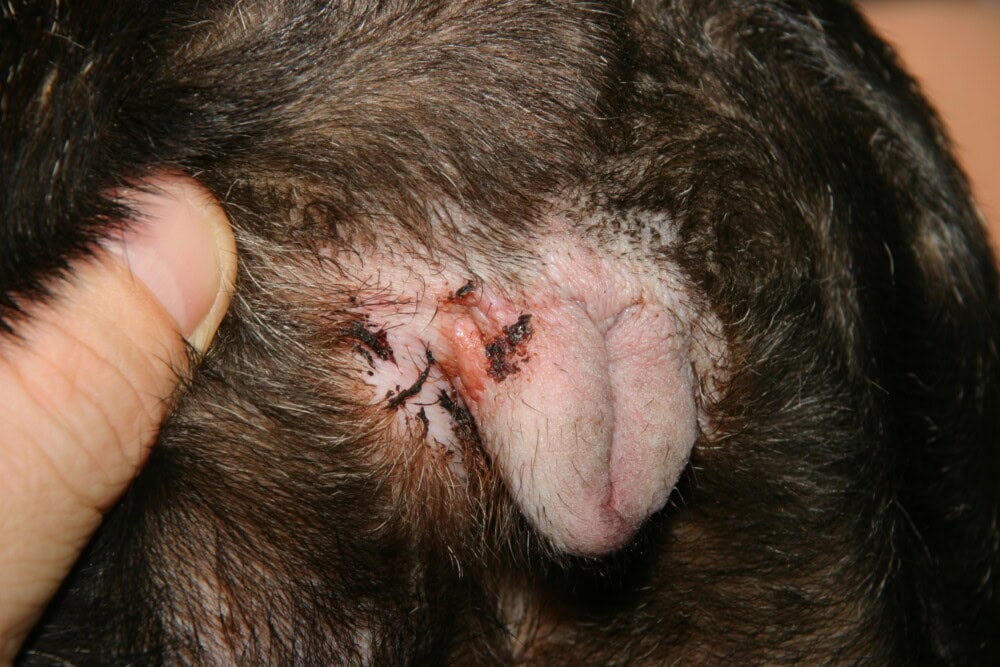
Vulvar skin fold dermatitis
In the Male: Scrotal Dermatitis
The scrotum, by virtue of the thinness and sensitivity of its epidermis, represents a preferential zone for inflammatory dermatological reactions in the male dog. The particular thinness of the scrotal epidermis, combined with its direct exposure to the environment, renders it highly reactive to allergic, irritant and infectious stimuli. Scrotal dermatitis is frequently observed, with an aetiological spectrum comprising allergic reactions — atopy, contact allergy — bacterial infections, and Malassezia dermatitis. Contact with irritant substrates, household products or rough surfaces may also trigger or exacerbate this presentation, particularly in animals in prolonged contact with chemically treated surfaces. Cutaneous cytology rapidly orients towards the pathogen or pathogens involved and guides topical treatment. Recurrent scrotal dermatitis must systematically raise suspicion of underlying atopic dermatitis, of which it may constitute one of the predominant clinical manifestations.
Perigenital Tumours
Tumours affecting the perigenital region remain less frequent than those of the perianal region, but merit consideration in the differential diagnosis of any progressively growing perigenital mass. Amongst the perigenital neoplasias encountered in the dog, transmissible venereal tumours, squamous cell carcinomas and various mesenchymal tumours may be cited. Transmissible venereal tumour, although still uncommon in Western Europe, should feature in the differential diagnosis of perigenital masses in dogs with a history of travel to enzootic areas. Surgical treatment generally constitutes the first-line therapeutic approach for benign or localised perigenital tumours, whilst malignant forms may require a combined approach associating surgery, chemotherapy or radiotherapy according to histotype and stage.
Summary
The management of perianal, perineal and perigenital dermatological conditions in the dog rests upon a rigorous clinical approach, articulated around three complementary axes. Firstly, precise knowledge of regional anatomy, which determines recognition of the structures involved and interpretation of the observed lesions. Secondly, refined semiology distinguishing acute from chronic conditions, pruritic from painful presentations, and anal sac disorders from independent cutaneous dermatoses. Thirdly, judicious recourse to ancillary examinations — cytology, targeted bacteriological culture, imaging, biochemical work-up — whose diagnostic value must be interpreted in clinical context rather than in isolation.
The algorithmic approach based on the chronology of lesions — acute or chronic — constitutes a particularly valuable structuring tool for the practitioner confronted with the diversity of perineal clinical presentations. This approach enables hierarchical organisation of the differential diagnosis, selection of the most pertinent ancillary examinations, and avoidance of unnecessary investigations or non-targeted empirical treatments.
Two transversal lessons merit particular retention. On the one hand, systematic bacteriological culture of anal sac contents does not constitute a reliable diagnostic tool in the absence of a clinical context of confirmed abscess, owing to the habitual presence of micro-organisms in this compartment in healthy animals. On the other hand, systemic antibiotic therapy must be reserved for situations where it is genuinely justified — abscess with sensitivity testing, documented superinfection — and must in no circumstances constitute an empirical first-line treatment for uncomplicated inflammatory presentations.
Research perspectives in this field concern notably the understanding of the precise immunopathological mechanisms of canine perianal fistula, whose complexity remains partially elucidated — in particular the role of the perianal microbiota as a factor potentially modifiable by treatment — as well as the identification of predictive biomarkers of recurrence for hepatoid tumours. The prospective evaluation of new immunomodulatory molecules, such as JAK inhibitors applied to perianal fistula, opens promising therapeutic avenues that will merit documentation through controlled clinical trials. Furthermore, the improvement of pre-operative staging techniques for apocrine gland adenocarcinoma of the anal sac — notably through systematic recourse to computed tomography and the development of molecular markers predictive of metastatic potential — as well as the evaluation of stereotactic body radiotherapy in multimodal treatment, constitute active research axes likely to significantly improve the prognosis of this tumour.
Conclusion
The perianal, perineal and perigenital regions concentrate, within a restricted anatomical territory, a remarkable diversity of dermatological conditions whose aetiologies, mechanisms and treatments differ fundamentally. These regions play an important role in canine social communication, which fully justifies the clinical attention devoted to them beyond their purely medical importance. Systematic rectal examination, rigorous analysis of the chronology of lesions, and cytology performed judiciously enable accurate diagnostic orientation. The distinction between functional anal sac disease, immune-mediated inflammatory processes, allergic dermatosis, and neoplasia directly determines the effectiveness of therapeutic management. Neglecting this region or reducing it to a superficial examination exposes the clinician to diagnostic delays with sometimes serious clinical consequences — notably in the case of apocrine gland adenocarcinoma of the anal sac, a tumour without an established sex predisposition, affecting all older animals regardless of sex, and whose high metastatic potential renders each week of diagnostic delay potentially detrimental to prognosis.
Maina E. From perianal to perigenital conditions in dogs. Practical programme of the 35th European Veterinary Dermatology Congress. Bilbao, Spain; 11–13 September 2025.
