

Canine pododermatitis does not constitute a single nosological entity, but rather represents a complex and multifactorial cutaneous reaction pattern, resulting from a dynamic interaction between primary causes, predisposing factors and perpetuating elements. This synthesis report aims to provide a comprehensive, nuanced and updated analysis of the etiology, pathophysiology and therapeutic strategies of canine pododermatitis.
This review integrates the most recent scientific data, including the 2025 guidelines from the ISCAID (International Society for Companion Animal Infectious Diseases) on rational antimicrobial use, the WAVD (World Association for Veterinary Dermatology) consensus on demodicosis and Malassezia dermatitis, as well as technological advances in fluorescence biomodulation. The analysis also relies on new trends in bacterial resistance observed in Europe and Asia, highlighting the urgency of a rigorous diagnostic approach and therapeutic management that conserves antibiotics.
In daily clinical practice, canine pododermatitis remains one of the most frequent reasons for consultation, but also one of the most frustrating for both the veterinarian and the owner. The clinical presentation, although often stereotyped—characterized by interdigital erythema, alopecia, edema, and sero-purulent exudation—masks considerable etiological diversity. This extends from banal environmental hypersensitivity to complex autoimmune disorders, including severe systemic metabolic diseases such as hepatocutaneous syndrome.
For the veterinary dermatologist, the challenge lies not only in the symptomatic management of inflammation or paw pruritus, but in the precise elucidation of the underlying pathogenic cascade. Inadequate management, often limited to repeated empirical antibiotic therapy without etiological investigation, inevitably leads to chronicity. The latter is characterized by irreversible dermal fibrosis, formation of follicular cysts, appearance of conformational modifications of the foot and emergence of multidrug-resistant bacterial strains, notably methicillin-resistant Staphylococcus pseudintermedius (MRSP) and Gram-negative bacilli such as Pseudomonas aeruginosa or Escherichia coli.
I. Pathophysiology and Functional Anatomy: The Disease Terrain
1.1 The Interdigital Cutaneous Barrier and Paw Microclimate
Understanding pathogenesis begins with analyzing functional anatomy. The skin of interdigital spaces has particularities that intrinsically predispose it to inflammation and infection. Unlike glabrous skin, the interdigital epidermis is exceptionally rich in sebaceous and apocrine glands. This glandular density, associated with the “closed” anatomical configuration of the interdigital space, creates a warm, humid and lipid-rich microclimate, particularly favorable to microbial proliferation.
This environment constitutes an ideal ecological niche for commensal populations, notably coagulase-positive staphylococci and the lipid-dependent yeast Malassezia pachydermatis. Moreover, the cutaneous barrier at this level is subjected to constant and intense mechanical constraints due to locomotion and the animal’s weight. Any alteration of this barrier, whether of allergic, parasitic or traumatic origin, allows the penetration of allergens and pathogens, triggering a local immune response that is often disproportionate.
1.2 The Concept of Follicular Cyst and Furunculosis: Mechanism of Chronicity
A central pathophysiological mechanism in establishing chronicity of pododermatitis is the rupture of the hair follicle, leading to furunculosis. This phenomenon is often poorly understood and wrongly termed a “sebaceous cyst.” Under the effect of initial inflammation (due to allergy or demodicosis) or frictional trauma (poor conformation, overweight), the follicular ostium becomes obstructed by hyperkeratosis. This obstruction leads to cystic dilation of the follicle.
The rupture of the weakened follicular wall then releases the follicle’s contents into the surrounding dermis: free keratin, hair shafts and bacteria. Keratin, once outside the follicle, is recognized as an endogenous foreign body by the immune system. It triggers a severe pyogranulomatous inflammatory reaction, initially sterile, which rapidly evolves toward deep bacterial infection. Hair fragments act as persistent irritative thorns, maintaining inflammation even after apparent bacterial sterilization. It is this foreign body reaction process that explains why antibiotics alone systematically fail to resolve chronic nodular lesions and why surgery or laser is sometimes required.
II. Algorithmic and Reasoned Diagnostic Approach
Faced with pododermatitis, the clinical approach must be rigorous, sequential and exhaustive to avoid diagnostic errors and unnecessary prescription of symptomatic treatments that mask the primary cause.
2.1 History and Clinical History: Initial Clues
Clinical investigation begins with detailed history. The age of onset is a major discriminating indicator. Pododermatitis occurring in a young dog (less than one year) should immediately direct the clinician toward juvenile demodicosis or early atopic dermatitis. Conversely, the appearance of paw lesions in an elderly dog, without dermatological history, requires considering serious metabolic causes such as hepatocutaneous syndrome, neoplasia (squamous cell carcinoma, cutaneous lymphoma) or autoimmune diseases (pemphigus foliaceus).
Seasonality of signs is another key element: exacerbation in spring or summer suggests environmental atopy (pollens), while non-seasonal pododermatitis may indicate food allergy or a non-allergic cause. The notion of contagion to other household animals or owners (pruritus in humans) points toward a zoonotic parasitic origin, such as sarcoptic mange, or fungal, such as dermatophytosis.
2.2 Dermatological Clinical Examination
Physical examination should not be limited to extremities alone. The distribution of lesions on the body provides valuable clues about etiology:
- Isolated pododermatitis (unipodal): This presentation suggests a local cause such as a foreign body (foxtail), trauma, neoplasia, or localized opportunistic fungal infection.
- Generalized pododermatitis (quadripodal): Simultaneous involvement of all four paws is highly suggestive of systemic causes: allergies (food or environmental), autoimmune diseases (pemphigus), metabolic causes, or leishmaniasis.
- Precise location on the foot: Pad involvement (hyperkeratosis, ulcers, depigmentation) points toward pemphigus, hepatocutaneous syndrome or leishmaniasis, whereas strictly dorsal interdigital involvement is more classic of atopy or demodicosis.
2.3 Immediate Complementary Examinations
Deep skin scraping and trichogram are non-negotiable imperatives. They must be performed systematically to exclude demodicosis, even in adult dogs receiving apparent antiparasitic prophylaxis (isoxazolines), as therapeutic failures, compliance issues or severe immune deficits may occur. In chronic forms with fibrosis, mites may be difficult to demonstrate by scraping; skin biopsy then becomes necessary.
2.4 Cutaneous Cytology: The Cornerstone of Infectious Diagnosis
Cytology, performed by direct impression, swab or fine needle aspiration for nodules, is the most cost-effective and informative examination. It allows objective quantification of:
- Bacteria: The distinction between cocci (generally Staphylococcus) and rods is crucial. The presence of rods should immediately alert the clinician to possible Gram-negative infection, potentially Pseudomonas, justifying immediate bacterial culture.
- Yeasts: Detection of Malassezia pachydermatis (bottle or peanut-shaped yeasts) is frequent in allergic pododermatitis.
- Inflammatory cells: Characterization of the infiltrate (degenerate neutrophils, eosinophils, macrophages, acantholytic cells) guides diagnosis. The presence of acantholytic cells in sheets strongly suggests pemphigus foliaceus.
III. Etiology: Detailed Classification of Primary Causes
It is fundamental to distinguish primary causes, which initiate the process, from secondary causes (infections) and perpetuating ones (anatomical modifications). Treatment of secondary causes without management of the primary cause inevitably leads to recurrence.
3.1 Allergic Dermatoses: The Predominant Cause
Allergies constitute, by far, the most frequent primary cause of chronic canine pododermatitis.
- Canine Atopic Dermatitis (CAD): Paw pruritus is a cardinal sign of CAD, often the first to appear. Interdigital erythema, initially ventral then dorsal, and compulsive licking lead to characteristic brownish coloration of hairs by salivary porphyrins (salivary chromonychia). ICADA guidelines emphasize the importance of multimodal management, targeting both cutaneous barrier dysfunction and immune dysregulation.
- Food Allergy (Adverse Food Reaction): Clinically indistinguishable from CAD, it may manifest as isolated pododermatitis or associated with digestive disorders (loose stools, borborygmi) and otitis. Elimination diet remains the diagnostic gold standard.
- Contact Dermatitis: Often underdiagnosed, it primarily affects glabrous areas in direct contact with the ground (palmar/plantar surface of digits, ventral interdigital spaces) while sparing dorsal hairy spaces. Frequent allergens include floor cleaning products, fertilizers, cements or certain plants (Pampas Grass, Tradescantia).
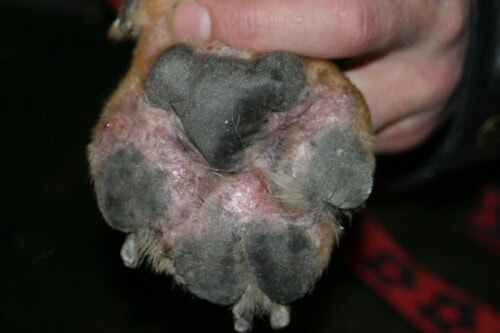
Pododermatitis of atopic origin
3.2 Parasitic Diseases
- Demodicosis due to Demodex canis: The paw form, or pododemodicosis, may be a chronic sequela of an unresolved juvenile generalized form or appear de novo in adulthood. In adults, it is often associated with underlying immunosuppression (hypothyroidism, Cushing’s syndrome, chemotherapy, long-term corticosteroid therapy). Lesions are typically scaly, alopecic, comedonal and hyperpigmented (“blue feet”), frequently evolving toward severe deep pyoderma with furunculosis and marked edema.
- Demodicosis due to Demodex injai: This parasite, morphologically longer than D. canis, resides preferentially in sebaceous glands. Although it classically causes dorsal seborrheic dermatitis (“greasy keratoseborrheic state”) in Terriers, it can also induce paw pruritus and diffuse erythema, often confused with allergy.
- Dermatitis due to Pelodera strongyloides: This saprophytic nematode penetrates skin in contact with damp and soiled bedding (straw). It causes erythematous, alopecic and extremely pruritic pododermatitis, affecting areas in contact with the ground.
- Hookworm infection: Ancylostoma larvae can penetrate percutaneously at the level of interdigital spaces, causing pruritic papular dermatitis and pad hyperkeratosis.
3.3 Endocrinopathies and Metabolic Diseases
Hypothyroidism and hyperadrenocorticism (Cushing’s Syndrome) do not directly cause inflammatory pododermatitis per se, but strongly predispose to secondary bacterial and fungal infections through alteration of cutaneous immunity and the epidermal barrier. Dystrophic cutaneous calcinosis, a complication of iatrogenic or spontaneous Cushing’s syndrome, may manifest as hard, whitish and calcified plaques on pads or in interdigital spaces, surrounded by a foreign body inflammatory reaction.
Superficial necrolytic dermatitis
Also called necrolytic migratory erythema, this is a serious dermatosis associated with severe chronic vacuolar hepatopathy or, more rarely, a glucagon-secreting pancreatic tumor (glucagonoma). Pathogenesis involves profound deficiency in circulating essential amino acids, leading to necrosis of keratinocytes in the granular layer. Paw lesions are characteristic and painful: severe pad hyperkeratosis with deep fissures, exudative erythema and adherent crusts. Histopathology reveals the pathognomonic “Red, White and Blue” sign (parakeratosis, edema, basal hyperplasia). The ultrasound appearance of the liver in “honeycomb” (honeycomb pattern) is highly suggestive.

Pododermatitis due to superficial necrolytic dermatitis
3.4 Autoimmune and Immune-Mediated Diseases
- Pemphigus Foliaceus: This is the most frequent autoimmune disease in dogs. It targets desmoglein-1, leading to superficial acantholysis. Clinically, it manifests as pustules (rarely intact because fragile), epidermal collarettes, yellowish crusts and villous pad hyperkeratosis, often painful. Claw involvement is rare, unlike facial and auricular involvement. Recent studies suggest that the presence of concomitant vasculopathic lesions worsens prognosis.
- Symmetrical Lupoid Onychodystrophy (SLO): This condition, preferentially affecting German Shepherds, Gordon Setters and Bearded Collies, is unique because it affects claws exclusively. It often begins with acute and painful loss of one or two claws (onychomadesis), followed sequentially by involvement of all claws on several paws. Regrowth is abnormal, producing brittle, deformed, short and friable claws (onychodystrophy). It is considered a vasculopathy or interface dermatitis specifically targeting the nail matrix.

Paw involvement in pemphigus foliaceus
3.5 Canine Leishmaniasis
In endemic areas (Mediterranean basin) or in dogs that have traveled, leishmaniasis due to Leishmania infantum must be systematically considered when faced with any pododermatitis. The parasite induces a complex immune response. Besides exfoliative dermatitis (giant scales), it causes spectacular onychogryphosis (abnormally long and curved claws like ram’s horns). This symptom is not simple hypertrophy, but results from chronic inflammation of the nail matrix mediated by deposition of circulating immune complexes. Pad ulcers, naso-digital hyperkeratosis and necrotizing vasculitis of ear tips are also frequent.
IV. Predisposing and Perpetuating Factors: The Vicious Circle
Recognition of these factors is as crucial as identifying the primary cause. Ignoring perpetuating factors condemns any medical therapy to long-term failure.
4.1 Conformational and Biomechanical Factors
Heavy short-haired breeds (English Bulldog, French Bulldog, Labrador, Boxer, Bull Terrier) are genetically predisposed. Obesity significantly worsens the problem by increasing pressure on pads and causing crushing of interdigital spaces (splayed toes). This crushing increases the skin-to-skin friction surface during walking. Moreover, so-called “wide” paws or those with deep webbing favor moisture retention and maceration.
4.2 “Traumatic Folliculitis” and Interdigital Cysts
Interdigital cysts and furunculosis are often maintained by a simple but devastating mechanical factor: hair type. In short-haired, stiff-coated breeds, broken hairs act like needles. During walking, constant friction pushes these broken hair shafts backward, into the dermis or through the follicular wall (ingrown hairs). This creates a vicious circle: inflammation → edema → increased friction → follicular rupture → foreign body reaction → fibrosis. Scar fibrosis ends up trapping follicular debris, forming chronic infection niduses inaccessible to antibiotics and immune defenses.
V. Advanced Therapeutic Management: 2025 Protocols
Management of canine pododermatitis is essentially multimodal. It must simultaneously:
- Treat infection (bacterial and fungal).
- Control inflammation and pruritus to stop self-trauma.
- Identify and manage the primary cause.
- Correct perpetuating factors (surgery, weight management).
5.1 Management of Bacterial Infections: New ISCAID 2025 Guidelines
The new ISCAID guidelines, published in 2025, mark a turning point in the approach to pyoderma, insisting on drastic reduction of systemic antibiotic use to combat growing antibiotic resistance.
Surface and Superficial Pyoderma
For infections limited to the surface (intertrigo) or superficial follicles, topical treatment is now the absolute first-line rule. Use of shampoos, foams or wipes containing chlorhexidine (2% to 4% concentration) is recommended daily or every other day. Mupirocin ointment is an excellent option for localized focal lesions, particularly against multidrug-resistant staphylococci.
Deep Pyoderma and Furunculosis
Systemic antibiotic therapy often remains necessary for deep forms (furunculosis, cellulitis), but must imperatively be guided by bacterial culture and antibiogram. Empirical antibiotic therapy is strongly discouraged in this context.
- Treatment duration: It is prolonged. Current recommendations advocate treatment of at least 4 to 6 weeks, and especially, continuation of treatment for 2 to 3 weeks after complete clinical resolution of lesions (disappearance of palpable nodules). Premature discontinuation is the main cause of recurrence.
- Choice of molecules (ISCAID Hierarchy):
- Level 1 (First-line if antibiogram favorable): Cephalexin, Amoxicillin-Clavulanic Acid, Clindamycin, Trimethoprim-Sulfonamides (TMS).
- Level 2 (Reserve molecules): Fluoroquinolones (Enrofloxacin, Marbofloxacin, Pradofloxacin), Doxycycline, Minocycline. To be used only on proof of resistance to level 1 molecules.
Recent Resistance Data (2024-2025)
Recent epidemiological studies conducted in Europe and China have revealed worrying trends. High resistance of Escherichia coli (often involved in chronic deep pododermatitis) to amoxicillin has been observed (up to 62% resistance). However, sensitivity to Trimethoprim-Sulfonamide (TMS) remains relatively stable, making it a more rational empirical option (while awaiting culture) than penicillins for suspected Gram-negatives. Resistance to amoxicillin-clavulanic acid shows a downward trend in some regions, suggesting preserved efficacy if used judiciously.
|
Type of Infection |
Recommended Therapeutic Approach (ISCAID 2025 Consensus) |
Average Treatment Duration |
Preferred Molecules |
|
Surface / Intertrigo |
Topical only (Chlorhexidine 4%, Mupirocin) |
2-3 weeks |
Local antiseptics |
|
Superficial |
Priority topical +/- Short systemic |
3 weeks (1 wk. after healing) |
Cephalexin, Clindamycin |
|
Deep (Furunculosis) |
Systemic (per antibiogram) + Adjuvant topical |
4-8 weeks + (2-3 wks. after healing) |
Per culture (often Fluoroquinolones, TMS) |
|
MRSA / MRSP |
Aggressive topical + Targeted systemic (if possible) |
Variable |
Chloramphenicol, Doxycycline |
5.2 Management of Fungal Infections (Malassezia)
Malassezia dermatitis frequently complicates allergies, causing intense pruritus, rancid odor and brownish exudate.
- Topical treatment: Often sufficient. Shampoos containing 2% miconazole and 2% chlorhexidine.
- Systemic treatment: In case of topical failure, severe involvement or conformation making local care difficult.
- Itraconazole: 5 mg/kg/day or pulsed protocol (2 consecutive days per week).
- Ketoconazole: 5-10 mg/kg/day (beware of hepatotoxicity).
- Terbinafine: 30 mg/kg/day.
5.3 Inflammation and Pruritus Management Strategies
Rapid pruritus control is essential to break the “pruritus-scratching-inflammation” cycle.
- Glucocorticoids (Prednisolone/Methylprednisolone): Remain the fastest and most effective tool to reduce severe edema and inflammatory fibrosis of interdigital cysts in acute phase. Anti-inflammatory dose (0.5-1 mg/kg/day) in short course.
- Oclacitinib (JAK Inhibitor): Very effective for controlling allergic pruritus with rapid onset of action (similar to steroids). Comparative studies (Little et al., 2015) showed that oclacitinib acts faster than ciclosporin and with fewer gastrointestinal side effects. It is ideal for therapeutic diagnosis of atopy.
- Lokivetmab (Anti-IL31 monoclonal antibody): Specifically targets interleukin-31, key mediator of atopic pruritus. It is a safe option, without metabolic or immunosuppressive side effects, usable in young dogs or those with comorbidities.
- Ciclosporin: Effective for chronic cases of atopy and certain autoimmune diseases, but its onset of action is slow (4 to 6 weeks for maximum effect), limiting its utility in acute phase.
5.4 Innovative Therapies: Fluorescence Biomodulation (Phovia)
Fluorescence Biomodulation (FLE – Fluorescent Light Energy) represents a major non-invasive technological advance for managing deep pyoderma and interdigital furunculosis.
- Mechanism: The Phovia system is based on application of a gel containing specific chromophores, illuminated by a blue LED lamp. The chromophores absorb blue photons and re-emit light energy by fluorescence at different wavelengths (green, yellow, red) in the visible spectrum. This energy penetrates at different dermal depths, stimulating cellular mitochondria, promoting ATP production, reducing inflammation and stimulating tissue regeneration, while having a direct bactericidal effect.
- Clinical Efficacy: Prospective randomized clinical studies (Marchegiani et al., 2021, 2022) demonstrated that adding FLE to standard antibiotic treatment significantly accelerates clinical healing (reduction of treatment time needed for resolution) and improves healing quality of deep lesions. A protocol of one weekly application proved statistically as effective as two applications per week, greatly facilitating owner compliance.
5.5 Surgical Options: The Last Resort
In cases of chronic fibrosing pododermatitis refractory to all optimal medical management (and only after strict control of primary causes), surgery may be considered as a salvage procedure.
- CO2 Laser Surgery: Allows precise excision of cysts, diseased follicles and fibrosed tissues with excellent hemostasis and operative site sterilization. It is the technique of choice for focal nodular lesions.
- Fusion Podoplasty: This heavy intervention consists of excising all diseased interdigital tissues and suturing digits together (pad fusion). Although effective in eliminating chronic pain and recurrent infections, it has a high rate of post-operative complications: wound dehiscence (very frequent), necrosis, and long and painful convalescence. Moreover, follow-up studies (Papazoglou et al., 2011) show that some dogs retain residual mechanical lameness or long-term gait discomfort. This surgery should only be proposed in ultimate cases (“end-stage pododermatitis”).
VI. Specific Treatments According to Etiology
Adaptation of protocol to precise etiology is the key to success.
6.1 Symmetrical Lupoid Onychodystrophy (SLO)
Treatment of SLO is essentially medical and must often be maintained for life.
- Basic protocol (Gentle immunomodulation): The combination of Tetracycline (or Doxycycline) and Niacinamide (Vitamin B3) is the historical treatment of choice. Recommended dosages are 250 mg of each (for dogs <20kg) to 500 mg of each (dogs > 20kg), three times daily. This protocol is often associated with massive supplementation in Essential Fatty Acids (Omega-3), particularly EPA (Eicosapentaenoic Acid), at high doses (400 mg/10kg).
- Refractory cases: If response is insufficient after 2-3 months, more powerful immunosuppressants such as Prednisolone, Azathioprine or Pentoxifylline (to improve microcirculation) may be added.
- Surgery: Claw removal (onychectomy) is very rarely necessary, except in case of uncontrollable pain on a specific claw. Spontaneous onychomadesis is part of the natural evolution of the disease.
6.2 Hepatocutaneous Syndrome (SND)
Prognosis is poor, with median survival often short. Management is palliative and essentially nutritional, aiming to correct hypoaminoacidemia.
- Amino acid infusion: Intravenous administration of crystalline amino acid solutions (Aminosyn 10% type) is the cornerstone of treatment. The protocol involves slow infusions (over 8-10h) repeated every 2 to 3 weeks to fill the catabolic deficit and reduce cutaneous lesions.
- Oral nutritional management: A diet high in high-quality proteins is imperative. Addition of raw egg yolks (3 to 6 per day depending on dog size) is a simple and effective method to provide amino acids. Zinc (Zinc Methionine) and essential fatty acid supplementation is also recommended.
- Advanced therapies: In rare cases of identified glucagonoma, surgical excision or use of somatostatin analogues (Octreotide) to inhibit glucagon secretion has shown promising results but remains costly.
6.3 Canine Leishmaniasis
Treatment is based on synergistic combination of a leishmaniocide and a leishmaniostat.
- Standard Protocol: Meglumine antimoniate (Glucantime) by SC injection for 4 weeks + Allopurinol per os long-term (6 to 12 months minimum).
- Alternative: Miltefosine per os + Allopurinol (useful in case of renal insufficiency limiting use of antimonials).
- Immune complex management: Allopurinol helps reduce parasite load and thus formation of immune complexes responsible for onychogryphosis and glomerulonephritis. Monitoring renal function is priority over managing cutaneous signs.
Conclusion
Management of canine pododermatitis requires the clinical veterinarian to question traditional practices. It is never a simple “paw infection” to be treated with an antibiotic injection, but a complex alarm signal reflecting local or systemic dysfunction. The key to therapeutic success lies in abandoning reflex antibiotic therapy in favor of a complete investigative approach (cytology, scrapings, biopsy) and multimodal therapy.
Integration of new ISCAID guidelines, favoring topical therapy, and adoption of adjuvant technologies such as fluorescence biomodulation, now allow management of cases formerly considered hopeless. Faced with worldwide emergence of bacterial resistance, the veterinary dermatologist must be the guardian of responsible, precise and factual medicine, where each prescription is justified by diagnostic proof.
References
Loeffler, A., Cain, C. L., Ferrer, L., Nishifuji, K., Varjonen, K., Papich, M. G., Guardabassi, L., Frosini, S. M., Barker, E. N., & Weese, J. S. (2025). Antimicrobial use guidelines for canine pyoderma by the International Society for Companion Animal Infectious Diseases (ISCAID). Veterinary Dermatology, 36, 234–282.
Marchegiani, A., Fruganti, A., Spaterna, A., Cerquetella, M., Tambella, A. M., & Paterson, S. (2021). The Effectiveness of Fluorescent Light Energy as Adjunct Therapy in Canine Deep Pyoderma: A Randomized Clinical Trial. Veterinary Medicine International, 2021, 6643416.
Mueller, R. S., Rosenkrantz, W., Bensignor, E., Karaś-Tęcza, J., Paterson, T., & Shipstone, M. A. (2020). Diagnosis and treatment of demodicosis in dogs and cats: Clinical consensus guidelines of the World Association for Veterinary Dermatology. Veterinary Dermatology, 31(1), 4–e2.
Bond, R., Morris, D. O., Guillot, J., Bensignor, E. J., Robson, D., Mason, K. V., Kano, R., & Hill, P. B. (2020). Biology, diagnosis and treatment of Malassezia dermatitis in dogs and cats: Clinical consensus guidelines of the World Association for Veterinary Dermatology. Veterinary Dermatology, 31(1), 27–e4.
Little, P. R., King, V. L., Davis, K. R., Cosgrove, S. B., & Stegemann, M. R. (2015). A blinded, randomized clinical trial comparing the efficacy and safety of oclacitinib and ciclosporin for the control of atopic dermatitis in client-owned dogs. Veterinary Dermatology, 26, 23–e8.
Auxilia, S. T., Hill, P. B., & Thoday, K. L. (2001). Canine symmetrical lupoid onychodystrophy: a retrospective study with particular reference to management. Journal of Small Animal Practice, 42(2), 82–87.
Papazoglou, L. G., Ellison, G. W., Farese, J. P., et al. (2011). Fusion Podoplasty for the Management of Chronic Pedal Conditions in Seven Dogs and One Cat. Journal of the American Animal Hospital Association, 47(6), e199–e205
Marsella, R. (2025). How to Determine the Causes of Pododermatitis in Small Animals. Today’s Veterinary Practice.
Bajwa, J. (2016). Canine pododermatitis. The Canadian Veterinary Journal, 57(9), 991–993.
World Association for Veterinary Dermatology (WAVD). (2025). Clinical Consensus Guidelines [Online]. Available at: wavd.org
International Society for Companion Animal Infectious Diseases (ISCAID). (2025). Guidelines for the diagnosis and management of bacterial urinary tract infections in dogs and cats.
Forsythe, P. (2015). Canine Pododermatitis. World Small Animal Veterinary Association World Congress Proceedings.
Outerbridge, C. A. (2013). Hepatocutaneous Syndrome. Veterinary Clinics of North America: Small Animal Practice.
