

Dermatoses of the canine nasal planum represent a unique diagnostic challenge for the veterinary practitioner, despite their relative frequency in dermatological consultations. The etiological diversity of these conditions, combined with the frequent overlap of clinical presentations, requires a rigorous methodical approach that our colleague Laura Ordeix presented at the last ESVD congress held in Bilbao, Spain.
Unlike in cats where neoplasias predominate, dogs primarily present inflammatory processes localized to this highly specialized anatomical structure. The objective of this review is to propose a systematized diagnostic approach, based on the recognition of specific lesional patterns, allowing effective guidance of clinical and paraclinical procedures.
Anatomical and Histological Particularities of the Nasal Planum
Macroscopic Organization and Topographic Subdivision
A detailed understanding of the architecture of the nasal planum constitutes an essential prerequisite for clinical interpretation. This structure is subdivided into three distinct topographic entities whose selective involvement has diagnostic value. The dorsal portion corresponds to the most extensive surface and the most exposed to environmental aggressions. The nostril orifices are delimited by the alar folds, while the central philtrum forms a vertical groove separating the upper portion of the lip.
This anatomical organization is not insignificant from a diagnostic standpoint. Certain conditions present preferential distribution: vasculopathies frequently target the philtrum due to its particular vascularization, while mucocutaneous pyoderma electively affects the alar folds.
Distinctive Histological Characteristics
The histology of the nasal planum differs substantially from that of adjacent haired skin. The surface presents a characteristic cobblestone architecture, composed of polygonal structures separated by deep grooves. This particular texture results from the complex organization of epidermal ridges.
The epidermis of the nasal planum manifests marked acanthosis, characterized by considerable thickening. The stratum corneum also presents notable thickness, with physiological hyperkeratosis that may be orthokeratotic or parakeratotic. Deep papillary ridges confer the characteristic relief to the surface. The disappearance of this architecture represents a major pathological sign, observed in various inflammatory conditions.
The dermis presents a remarkable particularity: the complete absence of adnexal structures. Neither sweat glands, nor sebaceous glands, nor hair follicles are identifiable in this region. Each papillary ridge contains an individualized neurovascular unit, probably involved in sensory functions, thermoregulation and maintenance of surface moisture.
Regional histological variations are observed within the nasal planum itself. The epidermis progressively thins at the level of the nostrils and philtrum. This latter structure presents a distinctive vascular particularity: its dermis contains arterioles of larger caliber, explaining its specific vulnerability to vasculopathies and arteritis.
Structured Diagnostic Methodology
Precise Identification of the Lesional Pattern
This first step relies on meticulous semiological analysis of observed lesions. The clinician must characterize the nature of the predominant involvement: is it a pigmentary modification, a loss of substance, an accumulation of keratinized material or a tissue proliferation? Topographic distribution simultaneously constitutes a discriminating criterion. A lesion strictly confined to the philtrum points toward a different etiological spectrum from that of diffuse involvement of the entire nasal planum.
Prioritization of Differential Hypotheses
For each identified pattern, the elaboration of a structured differential list is essential. This prioritization integrates the epidemiological prevalence of conditions, documented breed predispositions, age of onset and anamnestic data. A German Shepherd presenting erosions of the alar folds will primarily suggest mucocutaneous pyoderma, while a Labrador Retriever manifesting dry hyperkeratosis will point toward hereditary parakeratosis or idiopathic hyperkeratosis.
Complementary Investigation Protocol
Diagnostic confirmation requires sequential implementation of targeted complementary examinations. The approach progresses from non-invasive and immediately available techniques toward more complex investigations, reserved for situations where the first approaches remain inconclusive.
Lesional Classification and Differential Diagnoses
Pigmentary Alterations with Architectural Destruction
This pattern associates a chromatic modification of the nasal planum with progressive effacement of the normal cobblestone texture. On an initially black nose, depigmentation confers a smooth bluish-gray appearance, while a brown nose acquires a pinkish tint. Natural evolution leads to the appearance of erythema, then erosions, ulcerations and finally crusts in chronic forms.
Discoid lupus erythematosus constitutes the most frequently encountered etiology in this category. This autoimmune dermatosis typically begins with depigmentation of the dorsal portion, progressively extending to the alar folds and mucocutaneous junction. Leishmaniasis represents a major transversal differential diagnosis, particularly in Mediterranean regions and other endemic areas. Leishmanial lesions can perfectly mimic discoid lupus in their initial stages, with possibility of subsequent extension to peripheral haired skin.
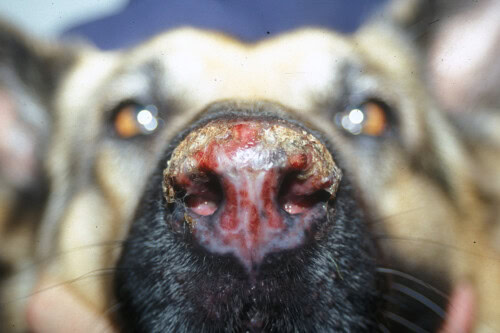
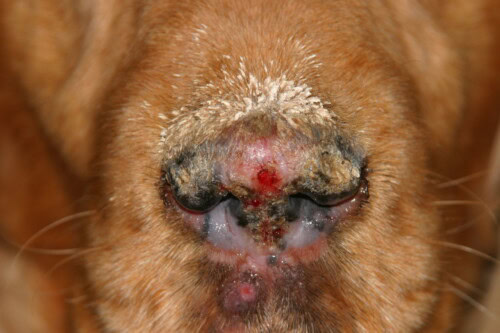
Nasal cutaneous lupus
Uveodermatological syndrome, also designated Vogt-Koyanagi-Harada-like syndrome, characteristically associates ocular manifestations with nasal involvement. The presence of concomitant uveitis strongly suggests this diagnosis, although cutaneous involvement may sometimes precede ocular signs. Ischemic dermatopathies, grouping various vasculopathies, can generate a similar clinical picture, frequently accompanied by extracranial cutaneous lesions, notably pedal or auricular.
Systemic lupus erythematosus, a less frequent generalized form, is usually accompanied by polymorphic systemic manifestations: polyarthritis, glomerulonephritis, autoimmune hemolytic anemia or thrombocytopenia. Cutaneous epitheliotropic T-cell lymphoma preferentially affects aged animals and generally presents other concomitant cutaneous locations: erythematous plaques, nodules or generalized exfoliative dermatitis.
Pigmentary Modifications without Structural Alteration
In this pattern, the color of the nasal planum changes while the cobblestone architecture remains completely preserved. The absence of inflammation constitutes the fundamental semiological characteristic.
Vitiligo manifests by progressive macular depigmentation, preferentially affecting certain breeds: Rottweiler, Doberman and Belgian Shepherd present increased susceptibility. This autoimmune condition targeting melanocytes typically affects several mucocutaneous junctions simultaneously: lips, eyelids and plantar pads may present similar modifications.
Idiopathic depigmentation, sometimes qualified as physiological and designated by the English expression “Snow Nose”, occurs in specific breeds such as Labrador Retriever or Siberian Husky. This chromatic modification, often seasonally reversible, is not accompanied by any inflammatory sign or alteration of surface texture.
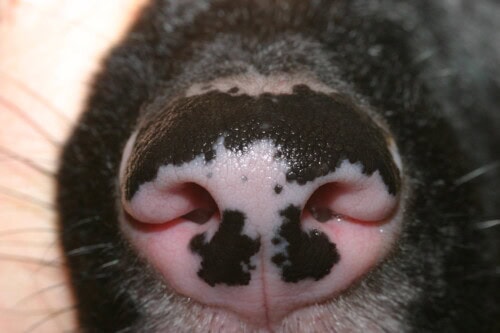
Vitiligo
Erosive and Ulcerative Dermatitis
Loss of substance characterizes this pattern, with variable prognostic implications depending on lesional extension and depth. Topography constitutes a major discriminating element, justifying subdivision into four subcategories.
Extensive Ulceration of the Nasal Planum
Complete and diffuse involvement of the nasal planum generally reflects severe conditions of sudden onset. Severe drug reactions, notably toxic epidermal necrolysis, cause massive epidermal destruction. This entity, analogous to human Stevens-Johnson syndrome, constitutes a dermatological emergency associated with a guarded prognosis.
Pemphigus represents a group of autoimmune bullous dermatoses. Pemphigus vulgaris, the most severe form, targets deep epidermal intercellular junctions, generating flaccid bullae rapidly evolving toward extensive erosions. Paraneoplastic pemphigus, a more recently described entity, is associated with an underlying neoplasia, frequently lymphoid. Bullous pemphigoid, targeting the dermo-epidermal junction, can also produce a similar picture.
Leishmaniasis, in its severe forms, generates extensive ulcerations capable of mimicking these autoimmune conditions. Nasal aspergillosis, although primarily a fungal infection of deep nasal cavities, can secondarily erode the nasal planum in neglected chronic cases.
Erosions Localized to Alar Folds
This lesional distribution primarily suggests mucocutaneous pyoderma, a particularly frequent condition in German Shepherds. This deep pyoderma electively affects mucocutaneous junctions, with nasal alar folds constituting a privileged location. Mucocutaneous lupus erythematosus, a benign variant of discoid lupus initially described in German Shepherds and Collies, presents similar distribution.
Leishmaniasis and nasal aspergillosis also figure among the differential diagnoses of this sub-pattern. Progressive extension from nasal cavities toward the external nasal planum characterizes aspergillosis in its advanced stages.
Ulcers and Fissures of the Rostral Portion
Deep linear fissures appearing on nostril margins define this sub-pattern. Nasal alar arteriopathy of the German Shepherd constitutes the specific etiology for this breed. This idiopathic vasculopathy generates bilateral and symmetrical linear ulcerations of the nasal wings.
Leishmaniasis, through its vascular tropism secondary to immune complex deposits, can produce morphologically similar lesions. Idiopathic vasculitides represent a heterogeneous group of conditions whose diagnosis relies essentially on exclusion of other etiologies.
Circumscribed Ulceration of the Philtrum
A single ulceration, well-delimited and localized strictly to the philtrum characterizes this highly specific sub-pattern. Dermal arteritis of the nasal philtrum, described preferentially in large breeds such as Saint Bernard, results from targeted inflammation of dermal arterioles in this region. The particular vascularization of the philtrum, characterized by the presence of larger caliber arterioles, explains this selective susceptibility.
During the healing phase of vasculitides affecting the philtrum, residual focal depigmentation is frequently observed. Leishmaniasis and idiopathic vasculitides complete the differential spectrum of this sub-pattern.
Squamo-Crusted Dermatitis
The accumulation of scales and crusts on the surface of the nasal planum defines this pattern, subdivided into two distinct entities according to the characteristics of accumulated material.
Squamo-Crusted Lesions of Pustular Origin
Friable yellowish crusts, easily detachable, indicate underlying pustular dermatitis. Pemphigus foliaceus, the most frequent autoimmune dermatosis in veterinary medicine, targets superficial epidermal intercellular junctions. Primary pustules, fragile and transient, rapidly evolve toward crusts. Symmetrical extension to the bridge of the nose and face constitutes an evocative semiological characteristic.
Pemphigus erythematosus represents a localized and clinically more benign form, considered by some authors as a variant of pemphigus foliaceus. Lesions generally remain confined to the face, with predominant involvement of the nasal planum and bridge of the nose.
Dermatophytosis, although rare at this location, deserves consideration. Nannizzia persicolor, formerly named Microsporum persicolor, presents particular tropism for glabrous areas and can generate a clinical picture mimicking pemphigus foliaceus, particularly in the presence of secondary bacterial superinfection.
Dry Hyperkeratotic Lesions
Marked thickening of the corneal layer confers to the nasal planum a dry, rough and frequently fissured appearance. Idiopathic nasal hyperkeratosis preferentially affects brachycephalic breeds. This condition, of unknown etiology, is characterized by excessive accumulation of keratin without identifiable underlying inflammation.
Naso-digital hyperkeratosis simultaneously affects the nasal planum and plantar pads, typically occurring in aged animals. Hereditary nasal parakeratosis, an autosomal recessive condition described in Labrador Retrievers, begins early in life and progressively evolves toward marked dry hyperkeratosis.
Zinc-responsive dermatosis groups several clinical entities linked to zinc deficiency, whether dietary or genetic. Nordic breeds present increased susceptibility to genetic forms. Superficial necrolytic dermatitis, also designated hepatocutaneous syndrome, is associated with severe hepatopathy or, more rarely, with pancreatic glucagonoma. Nasal hyperkeratosis is accompanied by characteristic pedal involvement and lesions of mucocutaneous junctions.
Leishmaniasis, in certain of its clinical presentations, generates nasal hyperkeratosis, sometimes accompanied by secondary bacterial superinfection. Distemper, although rare since generalization of vaccination, can occasionally cause naso-digital hyperkeratosis in its chronic forms.
Papulo-Nodular Dermatitis
The presence of papules or nodules, single or multiple, on the surface of the nasal planum defines this pattern. Granulomatous or pyogranulomatous processes, whether infectious or sterile, constitute the predominant etiologies.
Leishmaniasis frequently produces nodular lesions of the nasal planum. These nodules sometimes present a characteristic “volcanic crater” appearance, with a central ulceration surrounded by a peripheral rim. Sterile granuloma-pyogranuloma syndrome represents a group of idiopathic inflammatory conditions whose etiology remains unclear. The absence of identifiable infectious agents on cytological and histopathological examination constitutes a fundamental diagnostic criterion.
Deep mycoses, notably cryptococcosis, generate nodular lesions of the nasal planum. These systemic fungal infections preferentially affect immunodepressed animals. Protothecosis, infection by a ubiquitous alga, can also produce nasal nodules, although this location remains exceptional.
Reactive histiocytosis deserves particular attention. This histiocytic proliferation can engender diffuse and characteristic swelling of the nasal planum, designated by the expression “clown nose”. This massive tumefaction frequently causes respiratory stridor by mechanical obstruction of upper airways. Neoplasias, although less frequent in dogs than in cats, complete the differential spectrum of this pattern.
Diagnostic Investigation Strategy
First-Line Examinations
Cytology constitutes the essential initial examination in the investigation of dermatoses of the nasal planum. This simple technique, minimally invasive and immediately performable in the clinic provides valuable diagnostic information. Direct imprint smears or after superficial scarification allow identification of bacterial infections, yeasts, Leishmania amastigotes or acantholytic cells suggestive of pemphigus.
The quality of the sample conditions the reliability of results. Crusts must be gently lifted, underlying material collected and spread on slide. Intact pustules, when observed, represent privileged structures for sampling. Their content, rich in inflammatory cells and possible bacteria, offers optimal diagnostic window.
Blood and Serological Explorations
A complete hematological and biochemical panel is essential to evaluate general condition and search for systemic manifestations. Serum protein electrophoresis holds particular importance in the context of suspected leishmaniasis, this parasitosis being frequently accompanied by characteristic polyclonal hypergammaglobulinemia.
Urinalysis completes systemic evaluation, notably allowing detection of proteinuria suggestive of systemic lupus erythematosus or leishmaniasis with renal involvement. Leishmaniasis serology is systematically essential in endemic areas, independently of the observed lesional pattern. The diversity of clinical presentations of this parasitosis justifies this systematic approach.
Microbiological Investigations
Bacterial culture with antibiogram finds its indication in the presence of cytologically confirmed bacterial infection, particularly when it presents a deep or recurrent character. Mucocutaneous pyoderma of German Shepherds, frequently associated with resistant germs, particularly benefits from this approach.
Sampling must be performed after careful cleaning of the lesional surface, ideally at the level of an intact pustule or the bottom of a recent erosion. Fungal cultures are considered facing a suspicion of dermatophytosis or deep mycosis, although these conditions remain relatively rare at this location.
Molecular and Genetic Diagnostics
The genetic test for hereditary nasal parakeratosis of Labrador Retrievers constitutes a significant diagnostic advance. This non-invasive investigation, performed on salivary or blood sample, allows confirming the diagnosis before considering a biopsy. Animals homozygous for the mutation systematically develop the disease, while heterozygotes remain clinically healthy but can transmit the condition to their offspring.
Cutaneous Histopathology
Skin biopsy represents the reference examination for definitive diagnosis of numerous dermatoses of the nasal planum, particularly autoimmune conditions, neoplasias and sterile inflammatory dermatoses. The sampling technique substantially conditions diagnostic quality.
The biopsy site must be judiciously selected. Recent and active lesions offer the most characteristic histopathological modifications. The sample must include the lesional margin, simultaneously integrating affected skin and peripheral healthy skin. The center of a chronic ulcer, consisting of necrotic tissue, generally provides limited diagnostic information and should be avoided.
The punch biopsy technique of 6 or 8 millimeters constitutes the preferred approach. Several samples often prove necessary to increase diagnostic sensitivity, particularly in autoimmune conditions where histopathological modifications may present focal distribution. Immunohistochemistry and molecular biology techniques complete the diagnostic arsenal in complex situations, notably for differential diagnosis between inflammatory and neoplastic processes.
Practical Clinical Considerations
Diagnostic Therapeutic Approach
Mucocutaneous pyoderma illustrates the interest of a diagnostic therapeutic approach. Facing a German Shepherd presenting erosions of alar folds, instituting antibiotherapy constitutes a reasoned approach before considering a biopsy. Systemic or topical antibiotics, depending on lesional severity, are administered for two weeks.
A favorable clinical response, even partial, reinforces the hypothesis of mucocutaneous pyoderma and allows deferring biopsy. Conversely, total absence of improvement after this delay justifies rapid performance of a biopsy to explore hypotheses of mucocutaneous lupus erythematosus or other immune-mediated dermatoses.
Management of Recurrent Conditions
Mucocutaneous pyoderma, particularly in German Shepherds, frequently presents a recurrent character. This evolutionary chronicity usually reflects the existence of an underlying condition, with atopic dermatitis constituting the predominant etiology. Chronic antigenic stimulation secondary to allergy generates alteration of the cutaneous barrier and local immune dysregulation, favoring recurrent bacterial infections.
Long-term management imperatively requires identification and control of this primary atopic dermatitis. Isolated symptomatic treatment of infectious episodes, without management of allergy, inevitably leads to recurrences. Prolonged antigenic stimulation can theoretically evolve mucocutaneous pyoderma toward an immune-mediated dermatosis, illustrating the pathogenic continuum between infectious process and dysimmunity.
Importance of Leishmaniasis
Leishmaniasis deserves particular consideration in the diagnostic approach to canine nasal planum dermatoses. This vector-borne parasitosis, transmitted by sandflies, presents a predominant Mediterranean geographical distribution, with progressive extension toward northern territories previously unaffected.
The remarkable clinical polymorphism of this condition justifies its transversal position in differential diagnoses. Leishmaniasis can mimic practically all described lesional patterns: depigmentation with architectural destruction suggesting discoid lupus, extensive ulcerations simulating pemphigus, dry hyperkeratosis mimicking zinc-responsive dermatosis, or nodules suggesting a neoplastic process.
This semiological versatility imposes systematic performance of leishmaniasis serology in endemic areas, independently of the observed clinical picture. Detection of amastigotes on cytological examination, although highly specific, presents limited sensitivity. The absence of direct parasitic identification does not in any way exclude the diagnosis.
Perspectives and Diagnostic Challenges
The approach by recognition of lesional patterns transforms a complex diagnostic problem into a structured and reproducible process. This methodology allows rationalizing differential hypotheses and optimizing the use of diagnostic resources.
The constant evolution of knowledge in veterinary dermatology continuously enriches our understanding of these conditions. The progressive genetic characterization of hereditary dermatoses, such as nasal parakeratosis of Labrador Retrievers, opens non-invasive diagnostic perspectives. The development of molecular tools for detection of infectious agents improves diagnostic sensitivity.
Progress in immunodermatology refines our understanding of pathophysiological mechanisms underlying autoimmune dermatoses. This better pathogenic knowledge guides the development of targeted therapeutics, more effective and better tolerated than conventional immunosuppressants.
Modification of ecosystems and climate warming influence the geographical distribution of pathogenic vectors such as sandflies. This territorial expansion of leishmaniasis toward historically unaffected regions requires increased vigilance and adaptation of diagnostic protocols. The clinician must now consider this parasitosis in geographical contexts where it was previously exceptional.
Summary
Dermatoses of the canine nasal planum constitute a heterogeneous set of conditions whose diagnostic approach benefits from a structured methodology. Recognition of five main lesional patterns allows rationalizing the clinical process and prioritizing differential hypotheses. Detailed understanding of the anatomy and specific histology of this anatomical region illuminates semiological interpretation and explains certain selective lesional susceptibilities.
Cytology constitutes the first-line examination, rapidly providing valuable diagnostic information. Histopathology remains the reference investigation for definitive diagnosis of numerous conditions, particularly autoimmune and neoplastic dermatoses. Leishmaniasis, due to its remarkable clinical polymorphism, must be systematically considered in endemic areas.
The diagnostic therapeutic approach finds its place in certain specific clinical situations, notably mucocutaneous pyoderma. Recognition of underlying conditions, such as atopic dermatitis favoring recurrent infections, conditions the success of long-term management. The evolution of knowledge and development of new diagnostic tools continuously enrich our therapeutic arsenal and improve the prognosis of these conditions.
