

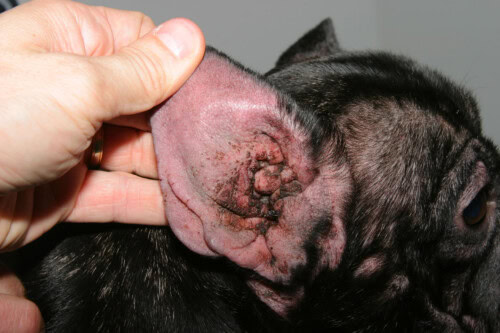
Chronic external otitis in dogs represents a frequent dermatological condition with a prevalence reaching 10.2% of veterinary clinical consultations. This inflammatory pathology of the auditory canal, often associated with underlying atopic dermatitis, generates considerable diagnostic and therapeutic challenges for practitioners.
The repercussions of this disease extend beyond the simple clinical dimension, profoundly affecting the welfare of affected animals and the quality of life of their owners confronted with the financial and temporal constraints of prolonged management.
Context and justification of the study
Chronic cutaneous pathologies exert documented impacts on quality of life in human medicine, particularly atopic dermatitis and psoriasis, generating sleep disorders, functional alterations, depression and anxiety. Canine atopic dermatitis similarly causes discomfort, pruritus and behavioral modifications in affected animals. A previous investigation demonstrated that this condition significantly decreases the quality of life of affected dogs and their owners, the latter suffering the emotional and financial consequences inherent to managing a chronic disease.
Paradoxically, despite the high prevalence of canine external otitis, the scientific literature remains particularly poor regarding the specific implications of this pathology on quality of life. A limited prospective study had previously confirmed the negative influence of external otitis on the welfare of dogs and their owners through the administration of questionnaires before treatment and seven days after intervention. Other works established that the use of an auricular gel combining terbinafine, mometasone and florfenicol positively improved quality of life by simplifying therapeutic administration and reducing application frequency.
Optimal management of recurrent cases requires the identification and exhaustive treatment of underlying factors according to the conceptual framework distinguishing primary, secondary, predisposing and perpetuating causes. Although numerous cases are resolved by general practitioners via conventional therapeutics, recurrences and progression toward chronicity remain frequent. For these complex situations, consultation or referral to a certified veterinary dermatologist constitutes a strategic option. A retrospective study demonstrated that this collaboration resulted in the resolution of clinical signs, reduced recurrences and significantly improved outcomes in dogs presenting chronic external otitis.
Infectious problem and resistances
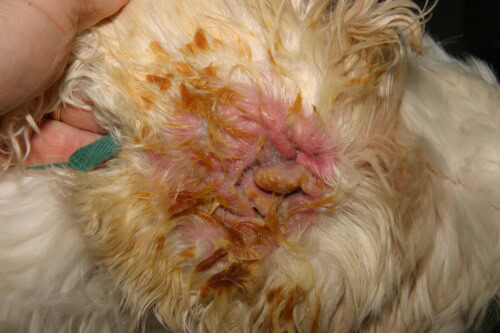
Chronic canine external otitis is accompanied by progressive dysbiosis that can evolve toward Pseudomonas spp. infection, a non-obligatory pathogen reported in 7.2% to 35.5% of cases according to studies. This infection is frequently associated with purulent exudate, biofilm formation, inflammation and ulceration of the auditory canal and concave pinna, substantially impacting animal welfare. Multidrug-resistant strains of Pseudomonas spp. prove common in canine auricular isolates, while biofilm production can be demonstrated in up to 99% of otic strains, factors correlated with unfavorable therapeutic outcomes.
Materials and methodology
Population and inclusion criteria
This prospective investigation, approved by the veterinary ethics committee of the University of Edinburgh, recruited thirty-one dogs presented to the dermatological referral service in Glasgow and to the university’s small animal hospital between February and September 2023. Inclusion criteria comprised persistent otitis of at least three months affecting one or two ears, performance of at least one video-otoscopy with auricular lavage at the referral center (designated Day 0) and minimal reexamination within the following four weeks.
The cohort included fifteen neutered males, five intact males and eleven spayed females, with a mean age of 68.7 months (range 14-148 months) and mean weight of 19 kilograms (range 5.18-43 kilograms). Spaniels represented the predominant breed with six cockers and three English springer spaniels, followed by three Labrador retrievers, two standard poodles and two French bulldogs. Eighteen dogs presented bilateral involvement and thirteen a unilateral form, totaling forty-nine affected ears.
Experimental protocol and data collection
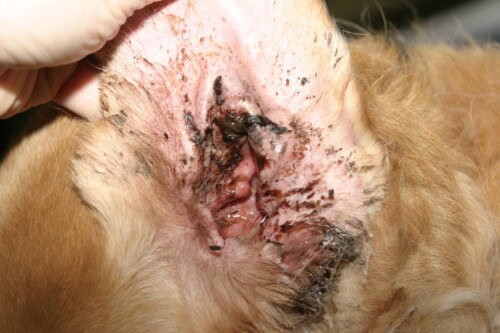
The mean age of otitis onset was 26.8 months (median 18 months, range 3-82 months). The mean duration of the episode before referral reached 35.4 weeks (range 1-122 weeks), with a mean of seven prior consultations with the referring veterinarian. Recorded information encompassed complete clinical history, age at presentation and at otitis onset, sexual and sterilization status, cytological and culture results, OTIS3 score, prescribed medications with possible adverse effects, pruritus visual analog scale scores, quality of life scores, post-referral resolution delay, number of follow-up visits preceding resolution, possible recurrences, final outcome and identified underlying primary disease.
Cytological and microbiological evaluation
Cytological examination of auricular exudate during the initial consultation revealed monocultures of Malassezia in eighteen ears, bacilli in six ears and cocci in two ears. Mixed infections combined Malassezia and bacilli in eight ears, cocci and bacilli in eight ears, cocci and Malassezia in five ears. Two ears presented no microorganism on cytological examination. Bacterial cultures, available for nineteen ears, primarily identified Pseudomonas aeruginosa in nine ears, one Pseudomonas aeruginosa and Malassezia association, one Pseudomonas mendocina and Proteus spp. association, two cases of Pluralibacter gergoviae with Malassezia, one Proteus mirabilis, and various associations including Enterococcus faecalis and staphylococci. Two cultures remained sterile.
Intervention procedure and follow-up
Otitis severity was quantified via the validated OTIS3 score, evaluating erythema, edema-swelling and erosion-ulceration in the vertical and horizontal canals, with a maximum score of twenty-four per ear. Owners completed a validated quality of life questionnaire evaluating the impact on their dog (questions 2-8) and themselves (questions 9-15), using a Likert scale (0=not at all, 1=a little, 2=fairly, 3=very much). The first question concerning disease severity was not included in the patient’s total quality of life score.
Initial medical management included oral glucocorticoids (prednisolone up to 1 milligram per kilogram once daily or methylprednisolone 0.8 milligram per kilogram once daily) and analgesia by paracetamol 400 milligrams-codeine 9 milligrams combination. Paracetamol was selected as an effective short-term analgesic, safely administrable with glucocorticoids and demonstrating non-inferiority versus meloxicam for postoperative analgesia. The prescription extended beyond the five days of British veterinary authorization according to clinical appreciation, at 10-15 milligrams per kilogram every 8-12 hours with owner consent.
All animals received general anesthesia according to standard protocols. Video-otoscopic examination evaluated each affected canal before and after rinsing according to the OTIS3 score, with video-photographic recordings. Auricular canals were irrigated with sterile 0.9% physiological saline via flexible catheter until obtaining a clean appearance. Reevaluations were performed at two to three week intervals until otitis resolution, then four to eight weeks subsequently.
Definition of evaluation criteria
Resolution was defined by the absence of discharge on examination, normal auricular cytological results and disappearance of auricular pruritus, pain, erythema, swelling, ulceration, exudate and unpleasant odor. Final outcomes were established according to three categories: resolution without relapse under specialist care, resolution of initial infection with subsequent relapse under specialist care, persistent otitis despite management or referral for total ear canal ablation with lateral bulla osteotomy.
Main results
Quality of life evolution
Mean disease severity scores (first question) were 2 (median 2, range 1-3) at pre-visit, 1.4 (median 1, range 0-3) at Day 0, 0.83 (median 1, range 0-2) at visit 1 and 0.52 (median 0, range 0-2) at visit 2. A statistically significant reduction in mean scores appeared between pre-visit and each subsequent visit.
For dogs, mean quality of life scores reached 7.96 (median 8, range 1-17) at pre-visit, 7.43 (median 6, range 1-14) at Day 0, 4.25 (median 4, range 0-18) at visit 1 and 3.56 (median 2, range 0-15) at visit 2. The reduction between pre-visit and Day 0 showed no statistical significance, unlike the highly significant reductions observed between pre-visit and visits 1 and 2. No statistically significant correlation was observed between the duration of the pre-referral episode and the quality of life score at pre-visit.
Mean quality of life scores for owners were 9.42 (median 9, range 2-19) at pre-visit, 8.06 (median 8, range 0-15) at Day 0, 5.38 (median 6, range 0-14) at visit 1 and 4.95 (median 4, range 0-12) at visit 2. Statistically significant reductions appeared between pre-visit and Day 0, between Day 0 and visit 1, and between pre-visit and visit 2. A moderate positive correlation was observed between owners’ quality of life scores at pre-visit and the duration of the episode before referral, approaching without reaching statistical significance.
Pruritus evolution and resolution delays
Mean pruritus visual analog scale scores were 5.46 (median 5.1, range 1-9) at pre-visit, 4.3 (median 5, range 0-9.5) at Day 0, 2.0 (median 1.5, range 0-7.5) at visit 1 and 1.17 (median 1.3, range 0-5.5) at visit 2, this last score falling within the normal range. Statistically significant reductions in pruritus appeared from pre-visit toward Day 0, visit 1 and visit 2. All dogs were still receiving oral corticosteroids at visit 1, compared to only four at visit 2.
The mean delay between pre-visit and Day 0 reached 17.93 days (median 15 days), between Day 0 and visit 1 of 19.89 days (median 15 days), and between visit 1 and visit 2 of 40.65 days (median 41 days). The mean time from initial consultation to resolution was forty-two days (range 21-84 days), requiring on average 3.6 appointments (range 3-6), including the video-otoscopic procedure. The mean delay from video-otoscopy to resolution reached 26.6 days (median 15.4 days, range 7-68.6 days). All patients received a single video-otoscopy with auricular lavage.
Therapeutic outcomes and prognostic factors
Of forty-nine ears, thirty-nine (79.6%) presented outcome 1 (resolution without relapse), nine (18.4%) outcome 3 (persistent otitis or surgery), and only one ear outcome 2 with recurrence 4.5 months after initial resolution confirmed by the certified dermatologist.
Mean quality of life scores for patients presenting outcomes 1 and 3 were respectively 10.31 (median 10, range 4-18) and 9.5 (median 10, range 3-13) at pre-visit. At visit 1, these scores reached 5.18 (median 5, range 0-19) for outcome 1 and 4.87 (median 5, range 0-8) for outcome 3. At visit 2, scores decreased to 4.53 (median 4, range 0-17) for outcome 1 and 3.28 (median 1, range 0-13) for outcome 3. Statistically significant reductions appeared between pre-visit and visits 1 and 2 for both outcome categories.
Mean OTIS3 scores during video-otoscopy proved higher for outcome 3 (12.8) compared to outcome 1 (9.51). Although not statistically significant at the 0.05 threshold, this trend suggested that a high OTIS3 score during video-otoscopy could be associated with unfavorable outcomes.
The presence of Pseudomonas spp. was strongly associated with therapeutic failure, the probabilities of unfavorable outcome being approximately thirteen times higher when this pathogen was identified. The age of otitis onset and episode duration constituted statistically significant predictors of outcome, late onset and prolonged episodes being associated with unfavorable results. No association appeared between patient age at referred presentation and outcome.
Long-term follow-up and underlying conditions
Follow-up at five and a half to six months was available for twenty-eight dogs, three being lost to follow-up. Four dogs examined in clinic presented otitis in remission. Two subjects with unfavorable outcome underwent total ear canal ablation with lateral bulla osteotomy and one was euthanized for hepatic neoplasia. One dog developed nystagmus and ataxia post-procedure, with subsequent diagnosis of otitis media by computed tomography.
Regarding underlying conditions, ten subjects received a diagnosis of canine atopic dermatitis, one of food allergy, and thirteen presented suspected allergy with investigation and management in progress or recommended. Two dogs presented unilateral auricular canal masses removed during video-otoscopy, identified histopathologically as polypoid hyperplasias.
Among the twenty-four cases of confirmed or suspected allergic otitis, one developed pruritic otitis after food provocation test and two consulted the general veterinarian for otitis within two to three months following resolution. Other ears remained in remission without veterinary consultation for otitis. Regular auricular cleaning with or without anti-inflammatory component was prescribed for all these cases.
Discussion and clinical implications
This investigation constitutes, to the authors’ knowledge, the first prospective study simultaneously evaluating the impact of chronic external otitis on the quality of life of affected dogs and their owners, while prospectively evaluating clinical results following specialist management. These results confirm the profoundly negative impact of chronic external otitis on the quality of life of both populations. The statistically significant reduction in scores between the initial visit and subsequent follow-ups underscores the beneficial effects of specialist intervention to relieve the animal’s physical discomfort and the owners’ emotional burden.
The improvement in owners’ quality of life score after the initial visit and before the video-otoscopic procedure is attributed to the prescribed treatment, the detailed explanation of the otitis and therapeutic plan with clarification of possible long-term prognosis after video-otoscopy. Unlike canine quality of life scores, for which a significant reduction appeared only at visits 1 and 2 compared to pre-visit, attributable mainly to a specific therapeutic pathway and video-otoscopic auricular rinsing.
The quality of life of subjects presenting persistent otitis and unfavorable outcome also improved temporally, suggesting that even without complete resolution, canine quality of life can progress. These findings indicate the value of specialist referral not only for clinical success, but also for improving comfort and general welfare, regardless of final therapeutic outcome, highlighting the broader benefits of specialist care beyond clinical resolution alone.
The mean resolution delay in 79.6% of affected ears reached forty-two days after initial consultation and 26.6 days after auricular rinsing. This result aligns with previous studies where 91% of chronic Malassezia otitis cases non-responsive to primary care were successfully managed within four weeks (median 27 days) following a single auricular rinsing intervention. The duration of pre-referral otitis was strongly associated with unfavorable outcomes, consistent with previous studies indicating that chronic otitis exceeding six months in primary care presents an unfavorable prognosis. A trend suggested that a high OTIS3 score could be associated with unfavorable outcomes.
Pseudomonas spp. otitis was significantly associated with therapeutic failure, the probability of unfavorable outcome being approximately thirteen times higher in the presence of this pathogen. Allergic cutaneous dermatitis represented the most common underlying condition in dogs presenting Pseudomonas spp. otitis, with a mean delay of twenty-eight months between first otitis appearance and infection by this pathogen. In this study, the mean delay reached 37.6 months. Ten of eleven Pseudomonas spp.-positive cultures were identified in eight of the nine spaniels and one spaniel crossbreed. Seven of ten ears with unfavorable outcome belonged to spaniels and one spaniel crossbreed, consistent with previous studies demonstrating the overrepresentation of cocker spaniels in canine populations presenting Pseudomonas spp. otitis and their predisposition to bacillary bacterial infections. Spaniels present a predisposition to proliferative ceraminous glandular hyperplasia and ectasia that can lead to terminal external otitis, justifying potentially more aggressive management of external otitis in this breed.
The OTIS3 scoring system constitutes a tool designed to evaluate and compare otitis and therapeutic outcomes. The authors nevertheless encountered difficulties in reliably evaluating OTIS3 scores, particularly during the initial consultation, due to pain, discomfort and profuse discharge making complete otoscopic evaluation impossible. Frequently, visualization of the horizontal canal was not attempted to avoid additional discomfort or proved simply impossible due to swelling and discharge. Affected patients often develop auricular phobia consequent to prolonged pain, further complicating thorough examinations even after otitis resolution. While the OTIS3 score presents value in research context, its application in clinical practice, particularly in patients presenting prolonged external otitis, presents certain limitations.
This study has several limitations including a relatively small sample size reducing statistical power to detect significant differences in therapeutic predictors such as OTIS3 scores. The absence of long-term follow-up also limited the investigation. External otitis reflects an underlying primary disease; without identification and management of this primary condition, future relapses of external otitis remain probable. For the majority of cases, atopic dermatitis and food allergy were diagnosed or suspected, with investigation or management of this condition pursued beyond the duration of this study. Computed tomography scans were not performed before therapeutic intervention. The absence of otitis media identification could cause future relapses of external otitis, this adjunctive diagnostic modality proving valuable in certain situations.
Chronic external otitis imposes a considerable burden both on the quality of life of affected dogs and their owners. Timely specialist referral nevertheless significantly improves clinical outcomes and quality of life. This investigation identifies several factors associated with unfavorable outcomes including the presence of Pseudomonas spp., high OTIS3 scores during video-otoscopy, late age of otitis onset and prolonged episodes. These results underscore the importance of a proactive and individualized approach to otitis management, particularly in patients at high risk of complications such as spaniels and those presenting Pseudomonas spp. infections. The findings also highlight the critical role of a multidisciplinary approach, where early specialist intervention can prove decisive in managing chronic and complex cases of external otitis.
Dembele V, McHale M, Ortalda C, Robinson V, Jackson H. A prospective study evaluating the impact of chronic otitis on the quality-of-life of dogs and their owners and assessment of the short-term impact of specialist intervention. Vet Dermatol. 2025;36(5):679-688.
